
Guides · Oct 17, 2026 · By Fish Tank Volume Calculator Team
How to Find the Volume of a Fish Tank (Measure, Calculate, Convert)
How to measure a fish tank and find its volume in litres and gallons, with formulas and worked examples for rectangular, cylinder, hexagon and corner tanks.

Your tank’s volume decides almost everything else in the hobby: how much water conditioner and medication to add, which heater and filter to buy, how much substrate you need and how many fish the tank can support. Getting it right takes a tape measure, a few minutes and the correct formula for your tank’s shape.
This guide shows you how to measure a fish tank properly, how to find its volume for every common shape, and how to turn the answer into litres and gallons.
What you need
- A tape measure or ruler (a rigid steel tape is easiest on glass)
- A notepad or your phone
- Optionally, a calculator, or the fish tank volume calculator, which does the maths for you
How to measure a fish tank
Accurate measurements matter more than the formula. A one inch mistake on a large tank can change the result by several gallons.
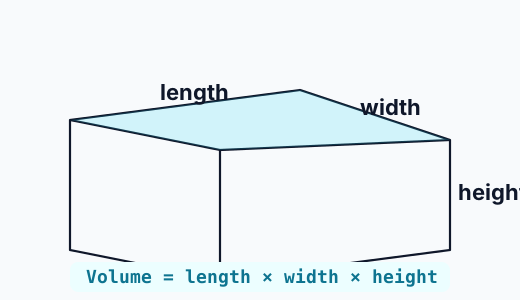
- Length: measure along the front of the tank, from the inside of one side panel to the inside of the other.
- Width (depth): measure from the inside of the front glass to the inside of the back glass, across the top.
- Height: measure from the top of the base glass to the water line, or to the rim if you want the full capacity.
Inside or outside? Inside measurements give the true volume. If you can only measure the outside, subtract the glass thickness twice from the length and width, and once from the height. Glass is usually 4 to 6 mm (about 1/4 inch) on small tanks and 8 to 12 mm on large ones. Also ignore any plastic trim around the top and bottom; it adds height without holding water.
Use one unit for everything. Centimetres convert most cleanly to litres. Inches convert most cleanly to US gallons. Never mix the two in one calculation.
How to find the volume of a rectangular fish tank
Most aquariums are rectangular boxes, so the formula is simply:
Volume = length x width x height
In centimetres: a tank that is 60 x 30 x 30 cm inside holds 60 x 30 x 30 = 54,000 cubic centimetres. Divide by 1,000 to get 54 litres.
In inches: a tank that is 24 x 12 x 16 inches holds 4,608 cubic inches. Divide by 231 to get 19.9 US gallons.
| Starting unit | To get litres | To get US gallons | To get UK gallons |
|---|---|---|---|
| Cubic centimetres | divide by 1,000 | divide by 3,785 | divide by 4,546 |
| Cubic inches | multiply by 0.01639 | divide by 231 | divide by 277.4 |
| Cubic feet | multiply by 28.32 | multiply by 7.48 | multiply by 6.23 |
Volume formulas for other tank shapes
Curved and angled tanks use the area of their base multiplied by the height. These are the same formulas the calculator on this site uses.
- Cylinder (round) tank:
volume = 3.1416 x (diameter / 2)² x height. A cylinder 40 cm across and 60 cm tall holds about 75.4 litres. Use the cylinder tank calculator. - Hexagon tank (regular, six equal sides):
volume = 2.598 x side² x height. With 25 cm sides and a height of 60 cm, that is about 97.4 litres. Use the hexagon tank calculator. - Corner bow front (quarter circle):
volume = 0.7854 x length x width x height. A 60 x 60 cm corner tank that is 50 cm tall holds about 141.4 litres. Use the corner tank calculator. - Bow front: the rectangular part plus a curved segment at the front. The maths is awkward by hand, so use the bow front calculator, which asks for the length, the width at the centre and at the ends, and the height.
- Triangle tank:
volume = 0.5 x length x width x height. Use the triangle tank calculator.
A worked example from start to finish
Say you have a tank with outside measurements of 24 x 12 x 16 inches and 1/4 inch glass.
- Inside dimensions: 24 - 0.5 = 23.5 in long, 12 - 0.5 = 11.5 in wide, 16 - 0.25 = 15.75 in tall.
- Full capacity: 23.5 x 11.5 x 15.75 = 4,256 cubic inches, which is 18.4 US gallons or 69.7 litres.
- Filled to one inch below the rim: 23.5 x 11.5 x 14.75 = 3,986 cubic inches, or 17.3 US gallons.
- Allow for substrate and decor: take off another 5 to 10 percent, for a real water volume of roughly 16 gallons.
That “20 gallon” tank actually holds about 16 gallons of water once it is set up, which is the number to use for dosing.
Tank volume vs real water volume
The formula gives you the capacity of the glass box. The real water volume is always lower because of the glass thickness, the gap at the top and everything you put inside the tank. A good rule of thumb is that a furnished tank holds 85 to 90 percent of its calculated volume. The water volume calculator shows how to measure the water depth above the substrate to get the real figure.
Use the real water volume for medication, salt and water conditioner. Use the full tank volume when you compare tank sizes or check the weight on a stand.
Common mistakes
- Measuring the outside of a thick-glass tank and treating it as the inside. On big tanks this can add several gallons.
- Mixing centimetres and inches in the same calculation.
- Using US gallon dosing on UK gallon measurements, or the other way round.
- Trusting the label. Rated sizes are rounded, so a “29 gallon” tank works out at about 28 gallons from its outside dimensions.
Frequently asked questions
What is the formula for fish tank volume? For a rectangular tank, volume = length x width x height. In centimetres, divide the result by 1,000 for litres. In inches, divide by 231 for US gallons. See the fish tank volume formula page for every shape.
How do I measure a fish tank that is already full? Measure the outside and subtract the glass thickness, which you can see at the top edge. Measure the height from the base to the water surface.
How many litres is a 60 x 30 x 30 cm tank? 60 x 30 x 30 = 54,000 cubic centimetres, which is 54 litres or about 14.3 US gallons.
Once you know your tank’s real volume, you can choose the right heater, filter and stocking level with confidence.