
Guides · Jul 12, 2026 · By Fish Tank Volume Calculator Team
How Much Aquarium Substrate Do I Need? Gravel, Sand and Soil
Work out exactly how much gravel, sand or aqua soil your aquarium needs, the right depth for your tank, and how many bags to buy, with a free substrate calculator.
Almost everyone buys the wrong amount of substrate the first time. You either come up short and have to make a second trip while your fish wait in a bucket, or you end up with three unopened bags of gravel taking up space in a cupboard. Neither is a disaster, but both are avoidable once you know the simple maths behind it.
Substrate is sold by weight, but your tank needs a volume to a certain depth. That mismatch is why guessing rarely works. This guide shows you how to turn your tank’s length, width and target depth into an exact litre figure, then into kilograms and the number of bags to buy, so you order once and get it right.
The quick answer
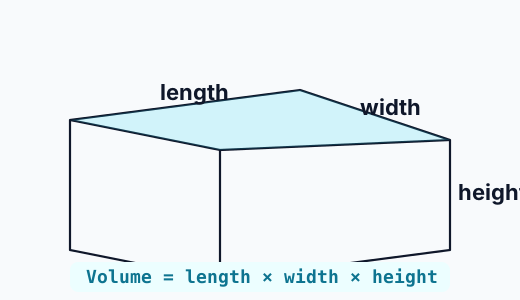
Substrate volume is length x width x depth. Multiply the three measurements in centimetres, divide by 1,000 to get litres, then multiply by the substrate’s density to get the weight:
- Gravel: about 1.5 kg per litre
- Sand: about 1.6 kg per litre
- Aqua soil: about 0.9 kg per litre
For a 60 x 30 cm footprint with a 5 cm bed, that is 60 x 30 x 5 = 9,000 cubic centimetres, or 9 litres. In gravel that is about 13.5 kg, so roughly two 10 kg bags with a little spare.
If you would rather not do the arithmetic, the aquarium substrate calculator does all of this instantly. Enter your tank length, width and depth, pick your substrate type, and it returns the litres, the weight in kilograms and pounds, and the number of bags to buy.
How deep should the substrate be?
Depth is the number most people get wrong, and it matters more than the tank size. Too shallow and plants cannot anchor; too deep and the lower layers go anaerobic and trap gas. Use the footprint of your tank, not its height, and pick a depth from the job the substrate is doing.
| Setup | Recommended depth | Why |
|---|---|---|
| Fish-only / bare-ish | 2.5 to 4 cm | Enough to cover the base and look natural, easy to keep clean |
| Community with some plants | 4 to 5 cm | Roots hold, waste sits on top where the filter can reach it |
| Planted / aquascape | 5 to 7.5 cm | Root feeders need room to spread; carpeting plants need a bed |
| Sand for corydoras / loaches | 2 to 3 cm | Shallow so it does not compact and go sour |
A useful rule: if the tank is planted, slope the substrate slightly deeper at the back (6 to 8 cm) and shallower at the front (3 to 4 cm). It gives depth for roots, hides equipment, and makes the aquascape look bigger. When you enter a depth in the calculator, use the average depth across the tank if you are sloping it.
Gravel, sand or aqua soil: which and how much
The type you choose changes both the weight you carry home and how the tank behaves. Here is how the three common options compare for the same 9 litre bed.
| Substrate | Density | Weight for 9 L | Best for | Watch out for |
|---|---|---|---|---|
| Gravel | ~1.5 kg/L | ~13.5 kg | Beginners, cichlids, easy cleaning | Debris falls between grains |
| Sand | ~1.6 kg/L | ~14.4 kg | Corydoras, loaches, natural look | Compacts; keep it shallow |
| Aqua soil | ~0.9 kg/L | ~8.1 kg | Planted tanks, shrimp | Costs more; breaks down over 1 to 2 years |
Notice that aqua soil is the lightest per litre but usually the most expensive, while sand is the heaviest. If you are lining a large tank, that weight adds up fast, which is another reason to measure before you buy rather than after.
A worked example for a standard tank
Say you are setting up a common 120 x 45 x 45 cm tank as a lightly planted community aquarium and you want an average 5 cm bed of gravel.
- Footprint x depth: 120 x 45 x 5 = 27,000 cubic centimetres.
- To litres: divide by 1,000 = 27 litres of substrate.
- To weight: 27 x 1.5 = 40.5 kg of gravel.
- To bags: at 10 kg per bag, that is five bags (round up, never down).
That is a lot of gravel, and it is easy to underestimate by eye. The substrate calculator shows the same result in one step, and if you switch to sand or aqua soil it recalculates the weight and bag count for you.
Does substrate reduce my water volume?
Yes, and it is worth accounting for. A substrate bed displaces water, so the tank holds less than its rated capacity once it is filled. In the 27 litre gravel example above, you lose roughly that much usable water, plus a little more for rocks and decor.
This matters for two reasons. First, medication and water-conditioner doses are based on the actual water volume, so an accurate figure keeps treatments safe. Second, stocking is based on real water, not the box on the tank. Work out your true water volume with the water volume calculator, then check how many fish that supports with the stocking calculator.
Common mistakes that cost a second trip
- Measuring the tank height instead of the footprint. Substrate sits on the base, so only length and width matter, plus the depth you want.
- Buying by “bags for a 40 gallon tank” charts. Those assume one depth. A planted 40 gallon needs far more than a fish-only one of the same size.
- Rounding down on bags. Substrate settles and you always want a little spare for future plant changes. Round the bag count up.
- Forgetting the weight. A filled tank plus a deep substrate bed is heavy. Once you know the substrate weight, add it to your full tank weight so your stand and floor can take the load.
Frequently asked questions
How much gravel do I need for a 20 gallon tank? A standard 20 gallon (about 75 litre) tank has roughly a 60 x 30 cm footprint. At a 5 cm depth that is about 9 litres, or around 13.5 kg of gravel. Enter your exact measurements in the substrate calculator for a precise figure.
How many kg of substrate per litre of tank? It is not per litre of tank, it is per litre of substrate. Calculate the substrate volume from length x width x depth, then multiply by density: about 1.5 kg per litre for gravel, 1.6 for sand and 0.9 for aqua soil.
Is sand or gravel better for a fish tank? Both work. Gravel is more forgiving for beginners and easy to clean; sand looks natural and suits bottom-dwellers like corydoras but must be kept shallow so it does not compact. Sand is slightly heavier per litre.
How deep should aquarium substrate be for plants? Aim for 5 to 7.5 cm in a planted tank so roots have room to spread, and consider sloping it deeper at the back. Fish-only tanks only need 2.5 to 4 cm.
Can I use too much substrate? Yes. Beds deeper than about 8 cm, especially fine sand, can trap gas in the lower layers. Keep sand shallow and stir deep planted beds occasionally, or add root tabs instead of piling on more.
Get your exact figure
Substrate is one of the few aquarium costs you can nail before you spend a penny. Measure the length and width of your tank, decide on a depth from the table above, and let the aquarium substrate calculator turn it into litres, kilograms and the number of bags to buy. One measurement, one trip, no leftovers.